Recovery Practice Models
See how Bridge to 100 member programs walk with a person from first contact to long-term recovery, side by side and in their own words.
How our member programs walk with a person toward recovery
12 member programs each shared a one-page practice model: the steps a person moves through, from first contact to long-term recovery. This page lays those models side by side, in each program’s own words, so you can see what they share and where they differ.
Looking for a program that could fit you or someone you know? Use Find a Program to filter by who a program serves, age, fee, and length.
Every program walks a similar road
Each program names its phases in its own words. To line them up, we group them into six shared stages. The names below are a network grouping, not any one program’s terms.
- 1Access & intake
- 2Stabilization
- 3Core recovery
- 4Growth, skills & work
- 5Transition & reintegration
- 6Alumni & ongoing support
-
Access & intake
Referral, application, screening, admission
9 of 12 programs have a phase here
-
Stabilization
First weeks: orientation, safety, routine, detox follow-through
12 of 12 programs have a phase here
-
Core recovery
Main residential recovery curriculum
11 of 12 programs have a phase here
-
Growth, skills & work
Vocational, education, leadership, service
11 of 12 programs have a phase here
-
Transition & reintegration
Supportive or transitional living, employment, exit planning
9 of 12 programs have a phase here
-
Alumni & ongoing support
Post-program support, internships, mentoring, aftercare
7 of 12 programs have a phase here
All 12 programs on one timeline
Each bar is one phase, in the order on that program’s slide, colored by shared stage. A faded, arrowed bar has no end point. A dashed bar has no stated length, so its width is a placeholder. Longest programs are first.
- Access & intake
- Stabilization
- Core recovery
- Growth, skills & work
- Transition & reintegration
- Alumni & ongoing support
Bars end at 24 months. Programs with open-ended support, such as aftercare or alumni, continue past that. Phase lengths marked “≈” in each program’s card are the network’s reading of the slide.
What most programs include
The services named most often across the practice model slides.
“Not listed” on a slide does not mean a program doesn’t offer a service. Ask the program.
The 12 practice models
Each card shows the program’s own phases in order, with the stage each one belongs to. Select a slide to open it in the PDF.
-

Adult & Teen Challenge, Sandhills NC
Southern Pines, North Carolina
- Men
Length: 9 months, divided into three phases, plus an optional 6-month internship
- Intake: AdmissionDay 1Access & intake
- Phase 1: Pre-Induction30 daysStabilization
- Phase 2: Induction90 daysCore recovery
- Phase 3: Training Center5 monthsGrowth, skills & work
- Phase 4: Optional Internship6 monthsAlumni & ongoing support
See details, entry requirements, and contact Original slide (PDF page 2)
-

Bethel Colony of Mercy: The Forge, Men's Program
Lenoir, North Carolina
Breaking the chains of addiction
- Men
Length: 65-day residential program
- Pre-BCOMLength not statedAccess & intake
- SmeltingDays 0 to 14Stabilization
- ForgingDays 15 to 65Core recovery
- Tempering: ExtensionLength not statedGrowth, skills & work
- Tempering: VSPLength not statedGrowth, skills & work
- Finishing: Post BCOMOngoingAlumni & ongoing support
See details, entry requirements, and contact Original slide (PDF page 3)
-
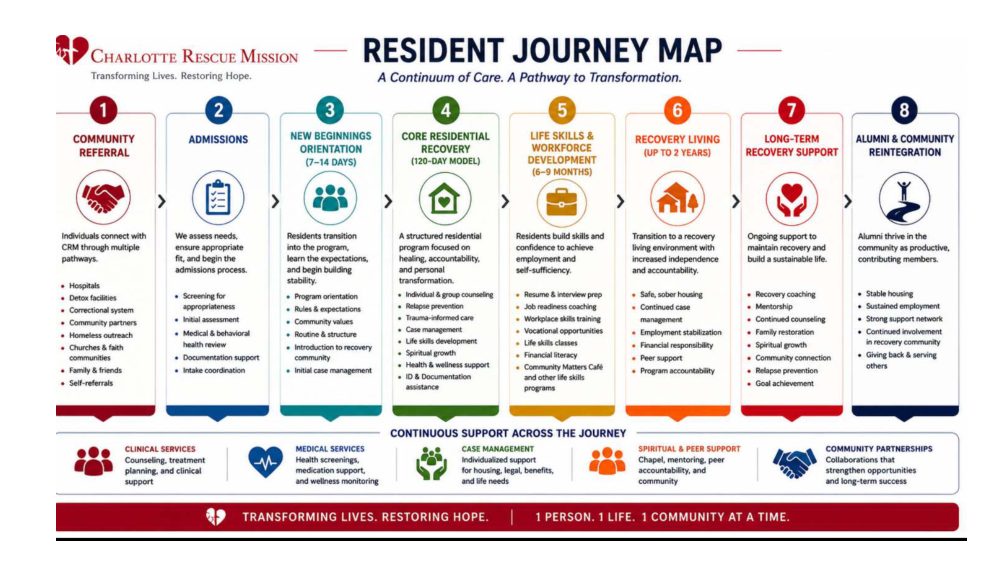
Charlotte Rescue Mission
Charlotte, North Carolina
Transforming Lives. Restoring Hope. 1 Person. 1 Life. 1 Community at a Time.
- Men
- Women
- Women with children ages 5 to 11
Length: 120-day core program; Recovery Living for up to 2 years after that
- 1. Community ReferralLength not statedAccess & intake
- 2. AdmissionsLength not statedAccess & intake
- 3. New Beginnings Orientation7 to 14 daysStabilization
- 4. Core Residential Recovery120-day modelCore recovery
- 5. Life Skills & Workforce Development6 to 9 monthsGrowth, skills & work
- 6. Recovery LivingUp to 2 yearsTransition & reintegration
- 7. Long-Term Recovery SupportLength not statedAlumni & ongoing support
- 8. Alumni & Community ReintegrationOngoingAlumni & ongoing support
See details, entry requirements, and contact Original slide (PDF page 4)
-

Christian Recovery Centers, Inc.
Shallotte, North Carolina
- Men
- Women
Length: Up to two years of residential care
- Clinical Detox (when necessary)Length not statedAccess & intake
- Residential Intake (Aspire implementation)Length not statedAccess & intake
- Treatment: Motivational Track4 to 6 weeksStabilization
- Recovery: Phases 1, 2 & 318 to 20 weeksCore recovery
- Re-entry: Phase 46 to 18 monthsTransition & reintegration
- Thriving / Well BeingOngoingAlumni & ongoing support
See details, entry requirements, and contact Original slide (PDF page 5)
-

Freedom Farm Ministries
Boone, North Carolina
- Men
Length: One-year program
- Day 1: Intake1st dayAccess & intake
- Phase 1: Safe House30 days minimumStabilization
- Phase 2: Restoration40 daysCore recovery
- Phase 3: Serving the Ministry40 daysGrowth, skills & work
- Phase 4: Discipleship Living CenterUp to 12 monthsTransition & reintegration
See details, entry requirements, and contact Original slide (PDF page 6)
-

Freedom House
Greensboro, North Carolina
Rescuing mothers. Redeeming lives.
- Women
- Women with children ages 0 to 10
Length: Full program 9 to 12 months / Aftercare option 12 months
- Intake/AdmissionDay 1Access & intake
- Level 1≈ 30 to 90 daysStabilization
- Level 2≈ 90 to 180 daysCore recovery
- Level 3≈ 180 to 270 daysGrowth, skills & work
- Level 4≈ 270 to 360 daysTransition & reintegration
- Aftercare (optional)12 monthsAlumni & ongoing support
See details, entry requirements, and contact Original slide (PDF page 7)
-

Ground 40
Monroe, North Carolina
- Men
Length: Free 6-month program, then transitional homes
- Farm40 daysStabilization
- Ranch2.5 monthsCore recovery
- Restoration2.5 monthsGrowth, skills & work
- Transition18 monthsTransition & reintegration
See details, entry requirements, and contact Original slide (PDF page 8)
-

Hope Center Ministries
Princeton, North Carolina
- Men
- Women
Length: 12-month program
- Pre-HCMDay 1 to admission/placementAccess & intake
- Phase 130 daysStabilization
- Phase 240 weeksCore recovery
- Phase 38 weeksGrowth, skills & work
- Post-HCMOngoingAlumni & ongoing support
See details, entry requirements, and contact Original slide (PDF page 9)
-
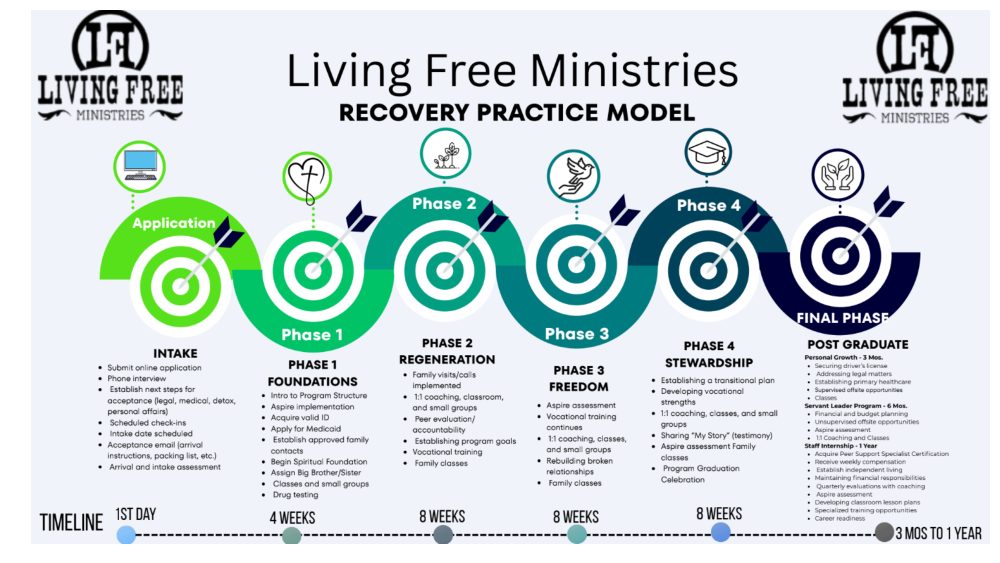
Living Free Ministries
Snow Camp, North Carolina
- Men
- Women
Length: 9-month men's program
- Intake1st dayAccess & intake
- Phase 1: Foundations4 weeksStabilization
- Phase 2: Regeneration8 weeksCore recovery
- Phase 3: Freedom8 weeksGrowth, skills & work
- Phase 4: Stewardship8 weeksTransition & reintegration
- Post Graduate3 months to 1 yearAlumni & ongoing support
See details, entry requirements, and contact Original slide (PDF page 10)
-

Raleigh Dream Center
Raleigh, North Carolina
- Men
Length: One year
- Intake: Referrals/AdmissionsDay one to 30 daysStabilization
- Phase 1: Christ-Centered Recovery, Steps 1 to 390 daysCore recovery
- Phase 2: Structured Daily Life90 daysCore recovery
- Phase 3: Education & Life Skills90 daysGrowth, skills & work
- Phase 4: Community & Accountability90 daysTransition & reintegration
See details, entry requirements, and contact Original slide (PDF page 11)
-
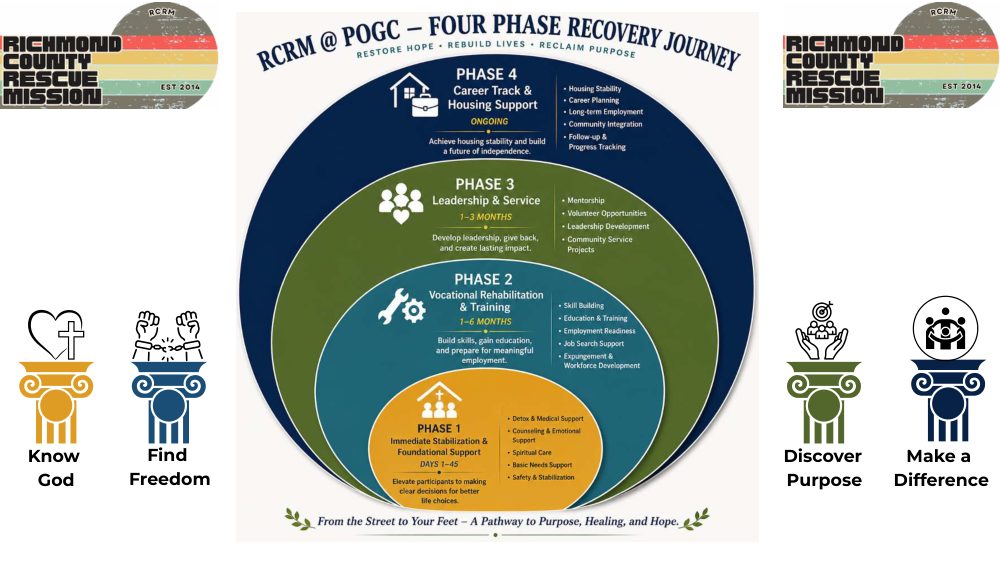
Richmond County Rescue Mission at POGC
Rockingham, North Carolina
Restore Hope · Rebuild Lives · Reclaim Purpose
- Men
- Women
Length: Not stated
- Phase 1: Immediate Stabilization & Foundational SupportDays 1 to 45Stabilization
- Phase 2: Vocational Rehabilitation & Training1 to 6 monthsGrowth, skills & work
- Phase 3: Leadership & Service1 to 3 monthsGrowth, skills & work
- Phase 4: Career Track & Housing SupportOngoingTransition & reintegration
See details, entry requirements, and contact Original slide (PDF page 12)
-
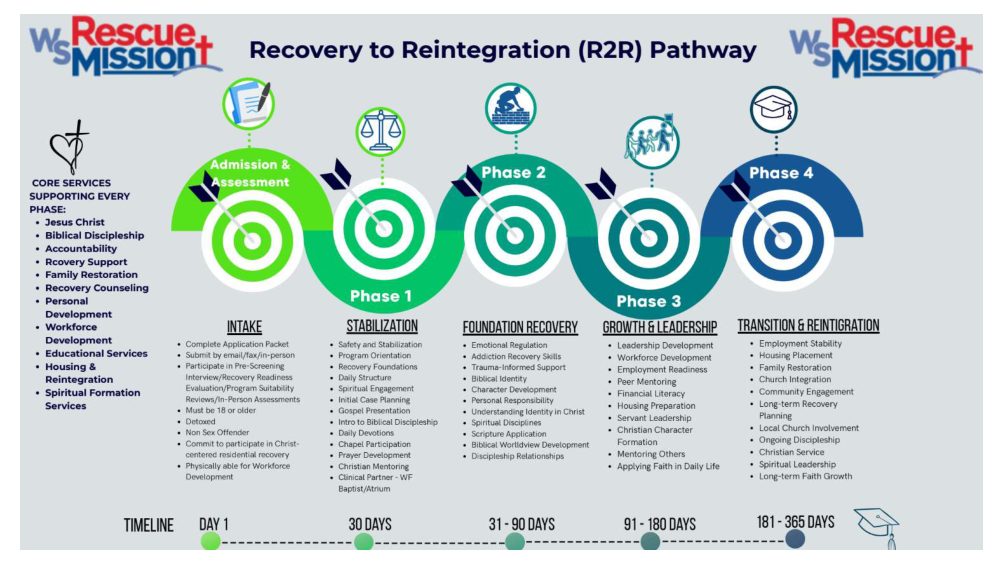
Winston-Salem Rescue Mission
Winston-Salem, North Carolina
- Men
Length: 12-month residential program
- Intake: Admission & AssessmentDay 1Access & intake
- Phase 1: StabilizationDays 1 to 30Stabilization
- Phase 2: Foundation RecoveryDays 31 to 90Core recovery
- Phase 3: Growth & LeadershipDays 91 to 180Growth, skills & work
- Phase 4: Transition & ReintegrationDays 181 to 365Transition & reintegration
See details, entry requirements, and contact Original slide (PDF page 13)
Find the program that fits
Filter programs by who they serve, age, detox, fee, and length. Compare up to four side by side, and print the comparison to share.
From practice models presented to the Bridge to 100 Network, October 2026. Names and wording are each program’s own. Stages are a network grouping. This page is not an eligibility decision; confirm details directly with each program.